It is hard to fault this classic tour that encompasses the three main grand temple sites of Angkor. If time only allows for a day at the temples then we would suggest this tour is the main afternoon feature.
Whilst the three sites are nearly always part of everyone’s standard Angkor temple circuit, we endeavour to time our visit and entry points that avoid the bulk of the crowds.
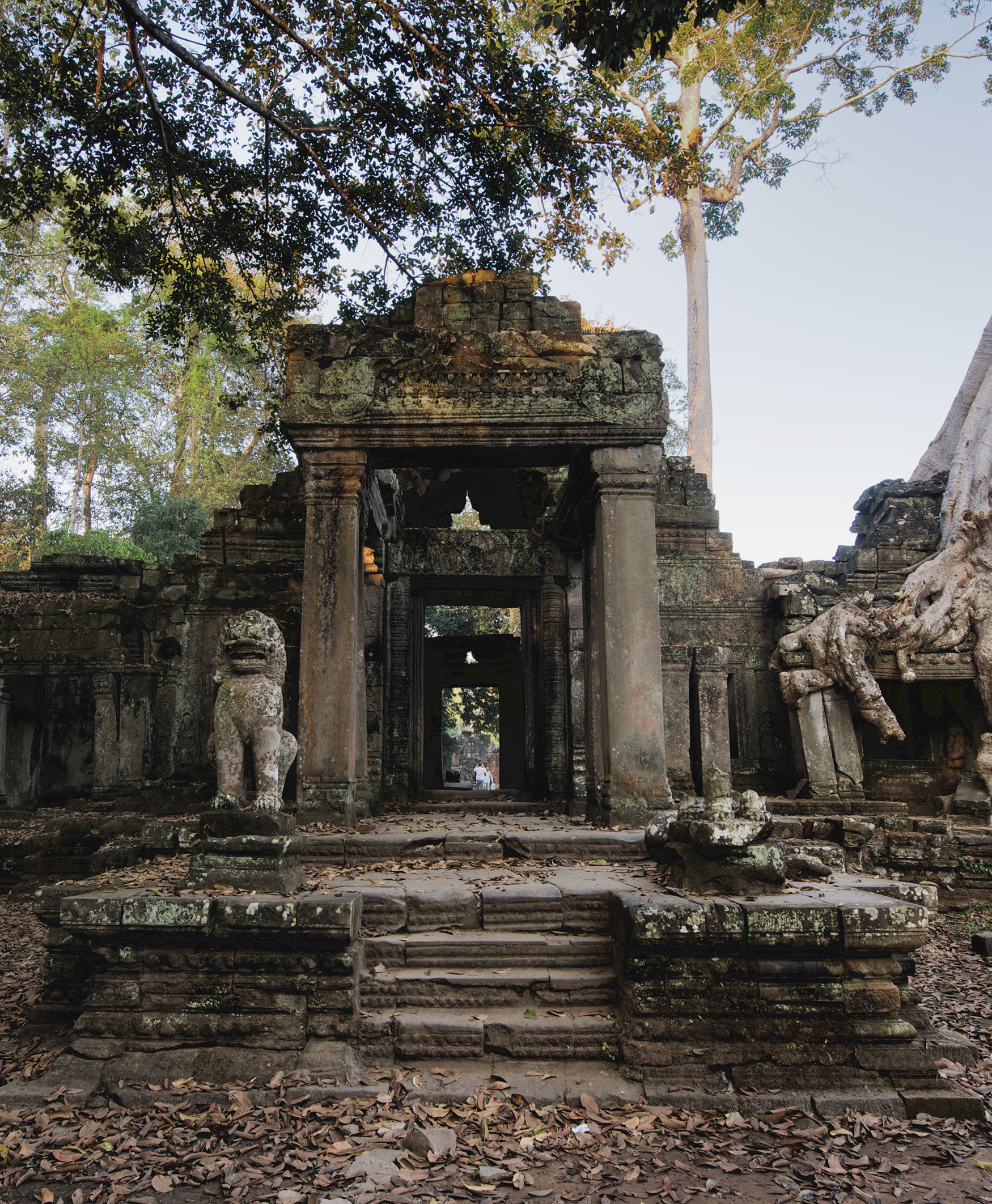
Our first stop on this afternoon tour is at Preah Khan temple, where we enter from it's rarely accessed south gate, where a wooden bridge connects the temple from its moat.
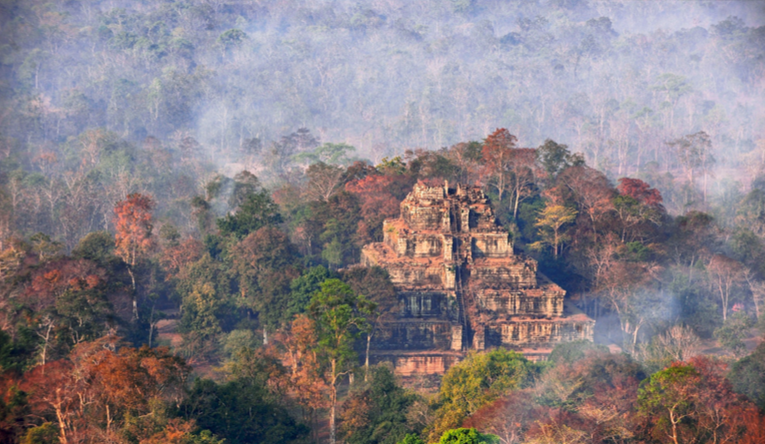
Preah Khan is incredibly vast and complex. It seems to be an endless labyrinth of rectangle courtyards and dark aisles. Outside of Cambodia, there are no comparably large forested areas as closely packed with ruins as Preah Khan. This 12th century sanctuary is Angkor's largest flat temple (meaning: all structures are on ground level, there is no elevated step pyramid).
Preah Khan’s original Sanskirt name was Nagara Jayashri, meaning “city of glorious victory", a reminder that at this place Jayavarman VII had defeated the Cham ruler of Angkor and thereby repulsed the foreign invaders. Preah Khan plays an important role in Cambodia’s history, as it is considered to have served as the first residence of Jayavarman VII within the area of Angkor and, due to this function, to have kept the royal insignia of this famous king, maybe for about a decade. Most probably, Preah Khan was the temporary capital of Jayavarman, while he was preparing his later capital, the nearby Angkor Thom.
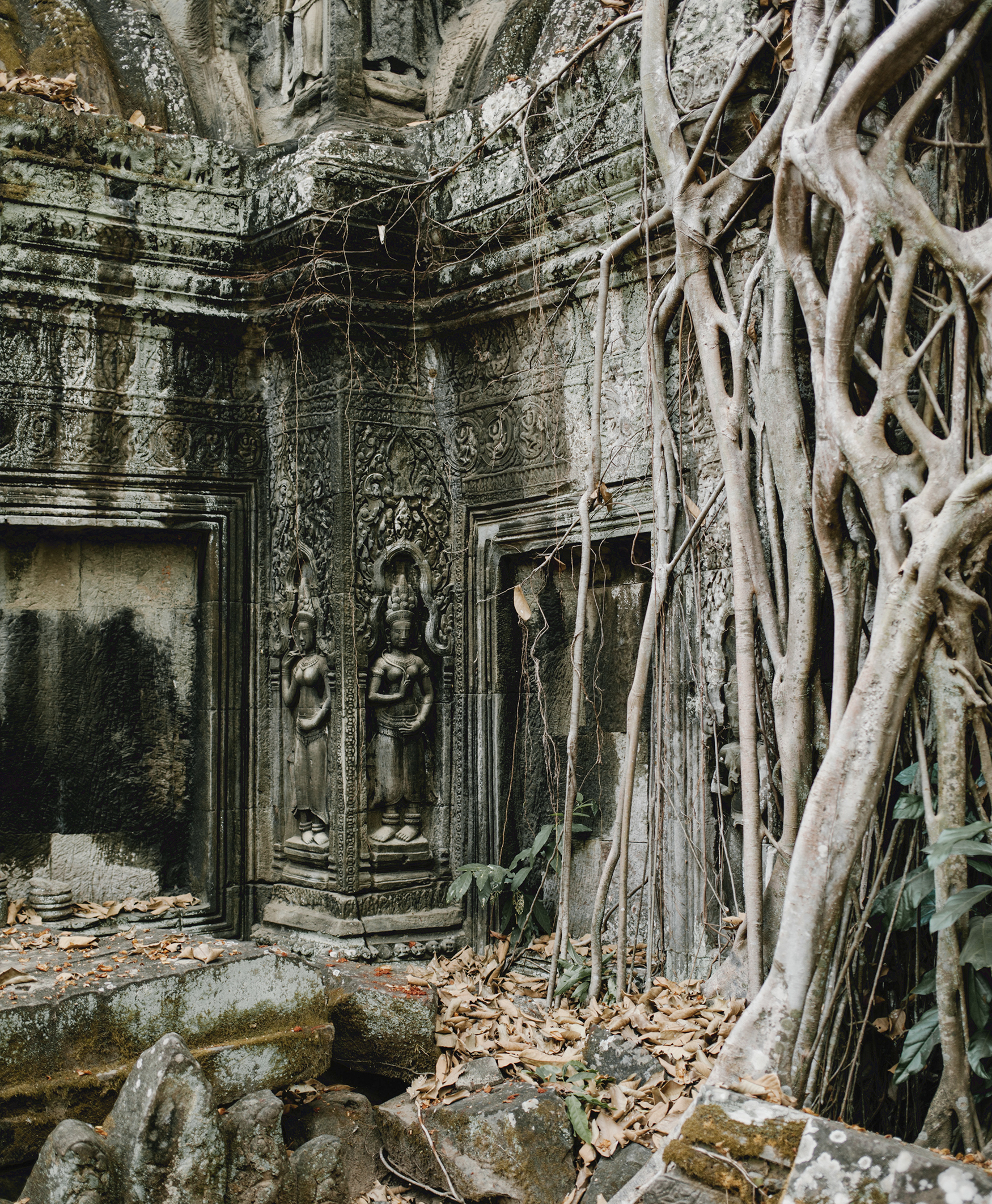
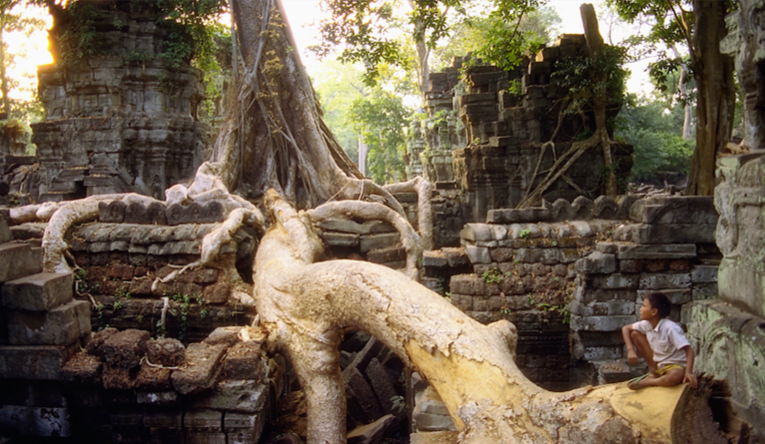
From here we return to our vehicle for the short transfer to the famed jungle temple of Ta Phrom - so called due to its present day enormous strangler figs (Ficus gibbosa) and even larger Thitpok trees (Tetrameles nudiflora) grown from the towers and hall. As with Preah Khan, we enter Ta Phrom from the far lesser visited northern gate and explore the site from there.
The temple, dating from 1187 originally was called Rajavihara, meaning "King's monastery" in Sanskrit. The modern Khmer name "Ta Prohm" means "Old Brahma". Ta Prohm was a monastery of enormous dimensions at 65 hectare. According to a temple inscription, 12,640 people lived here at its peak. Thousands of them were monks, but most of the inhabitants were laymen as supporters, including 615 female dancers. The monastery was enormously wealthy, as it had vast stores of silks, pearls, jewels and gold and was in charge of 3400 villages. It was a state within the state.
From Ta Phrom we head to the grand site of the Bayon. Our carefully timed visit falls after 4.30pm to absorb the calm of an early evening wandering around this vast monument.
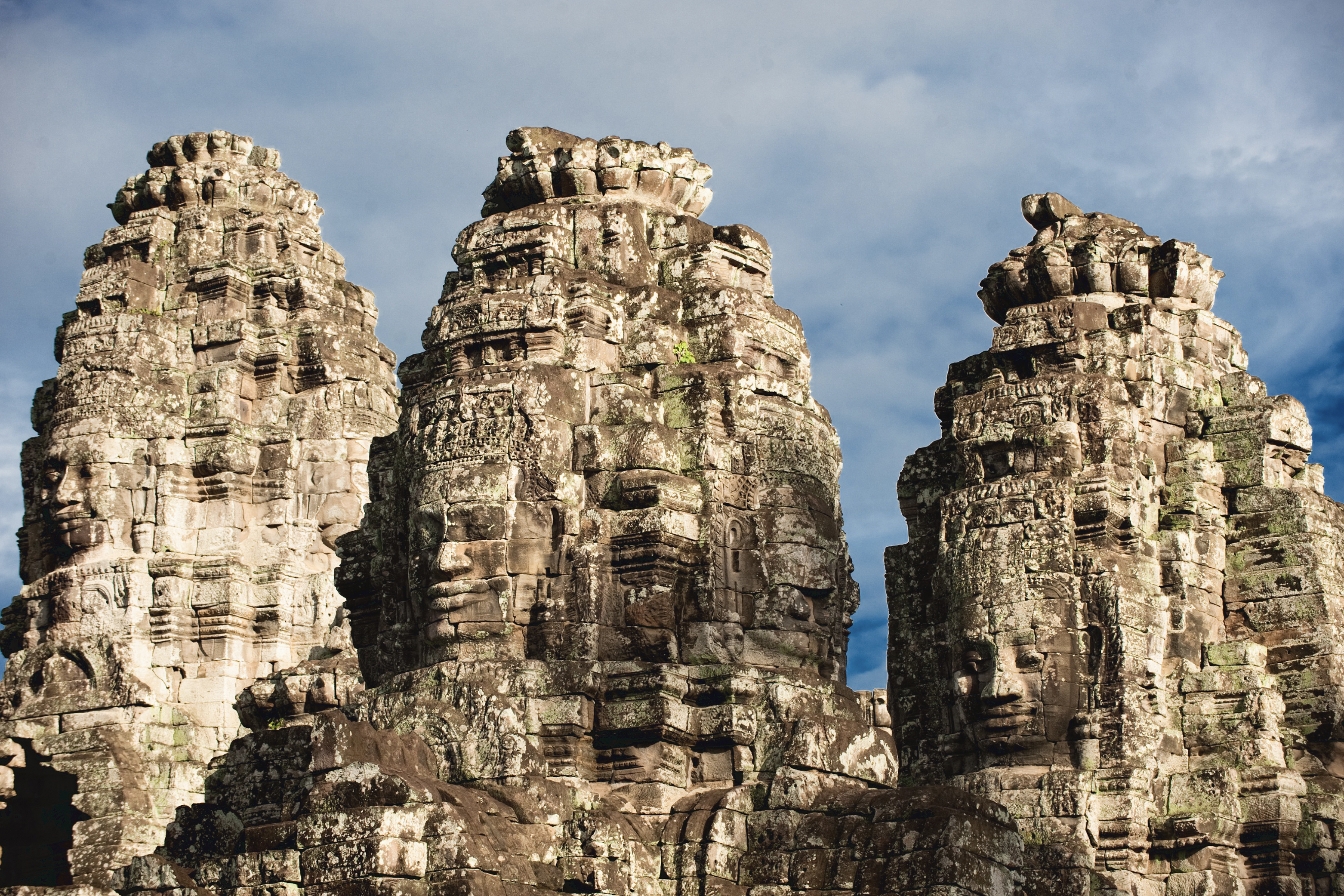
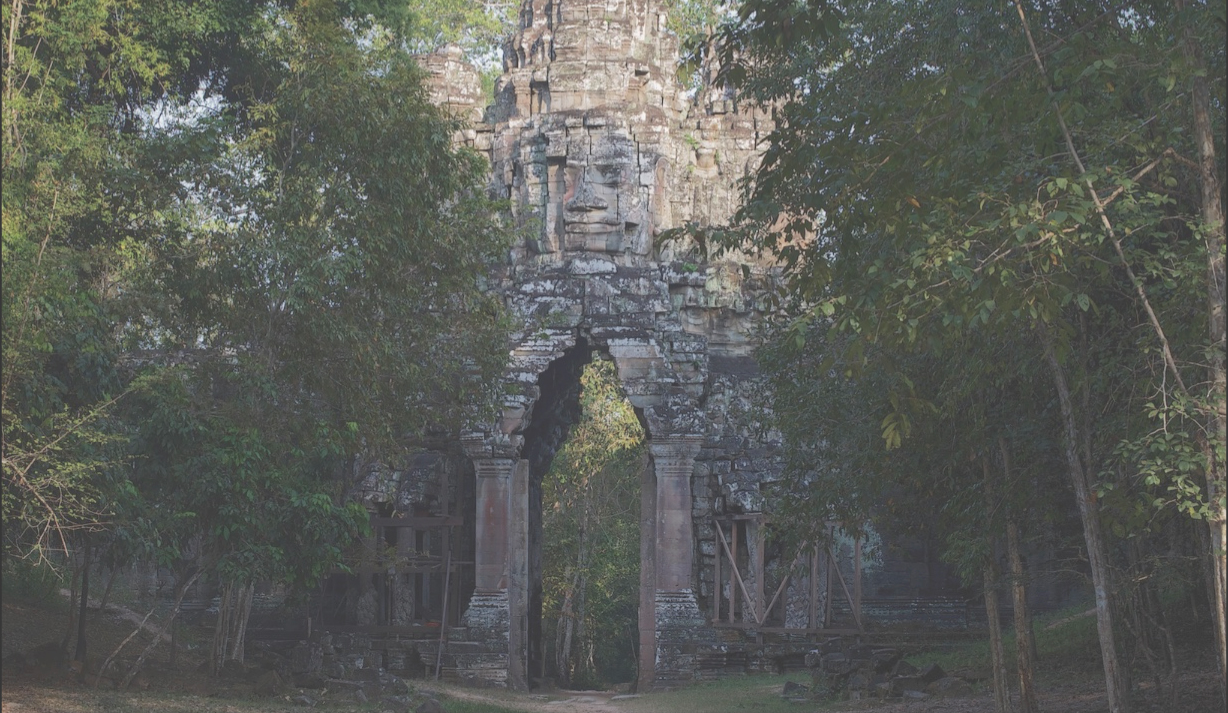
The Bayon, built in the centre of Angkor Thom about 1200 A.D., is the second most popular monument in Angkor, after Angkor Wa and was the state temple of King Jayavarman VII (1181- ca. 1218), who introduced Buddhism as the new state cult It is the temple with those numerous enigmatic "stone faces" Angkor is famous for. As it is not clear who or what is symbolized by those gigantic Buddhas, the remaining 37 towers of smiling faces of Angkor Thom have become an emblem of the mysteries of Angkor.
Apart from the face-towers, the large-scale carvings at the gallery walls are both overwhelming and delightful, because of its abundance of detail. The wall of the outer gallery features a series of bas-reliefs depicting historical events, marching and fighting troops, and scenes from everyday Khmer life.
Explore the Bayon in detail before we return to the hotel as it starts to get dark.
PROGRAM CONCLUDES